
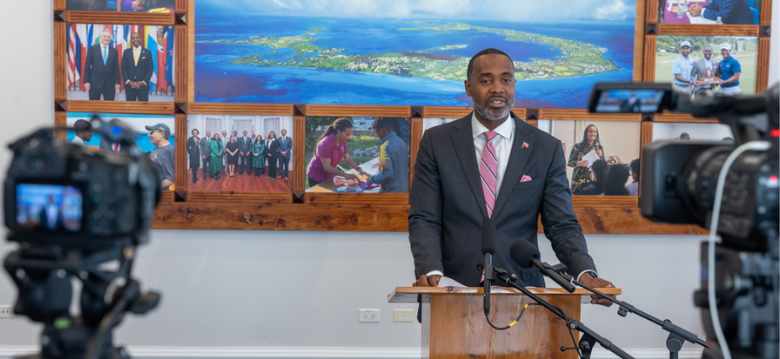
Good afternoon to members of the media gathered here at the Cabinet Office and to the people of Bermuda. On Friday, the 20th of February, the government delivered the 2026-27 Budget Statement in the House of Assembly under the theme Responsible Choices, Lasting Benefits for Bermudians.
This budget is the result of nine years of disciplined fiscal management and delivers relief for workers and families while also ensuring we address Bermuda's debt and make significant investments in our infrastructure and other critical areas.
Before I get into this year's budget, it's important that we look back at what we've achieved in previous years. In the last fiscal year, which ended on March 31, 2025, Bermuda achieved its first consolidated fund surplus in over two decades, a surplus of $29 million, and this was before a single dollar of corporate income tax was collected. That milestone was not an accident.
It was a result of this government’s successful execution of Bermuda's economic recovery plan, which followed the pandemic, followed by the implementation of the economic development strategy. Now, there will be those who cast doubt on this government's economic record, but they cannot and should not ignore the facts. Real GDP growth is estimated at 2.5% to 3% in 2025, outpacing many of our peers.
Unemployment stands at 1.4%, the lowest since 1970. Employment income has risen 5.8% to $3.57 billion, and inflation remains at 2.2%, below the level seen in the United States, United Kingdom, and Canada. For the current fiscal year that we are currently in, which ends on March 31, 2026, total revenue is projected at $1.554 billion, $123 million above our original estimates.
The first corporate income tax receipts totaled $279 million, exceeding our initial forecast of $187.5 million, and the projected surplus for this fiscal year is $153.1 million, which is $110 million above our estimates and, of course, is a record budget surplus. Our debt-interest-to-revenue ratio has now fallen below 10%, a target which was set by the Fiscal Responsibility Panel, which is an example that our fiscal metrics are getting better.
Thanks to better-than-expected revenue collections and economic performance, along with the addition of revenue from the corporate income tax, I'm pleased to announce that the government will repay $605 million in government debt in full by January 2027, when that debt becomes due.
This will reduce Bermuda's gross debt by 18% and will save taxpayers $25 million every year in interest costs. This is the single largest debt repayment in Bermuda's history. Turning to the next fiscal year, which was the subject of the budget, this government projects a total revenue of $2 billion.
This is the first time in Bermuda's history that government revenue will exceed $2 billion. Corporate income tax revenue is projected at $753.2 million and the projected budget surplus is $472.7 million. It is also important that I reiterate today what I stated in the budget statement regarding corporate income tax revenue.
Analysts indicate that 2025 may represent the high point of the corporate income tax revenue cycle. As the cycle continues and the tax credit framework matures, we should expect these revenues to moderate in future years. That is precisely why the government has decided, and this is a change, to not use CIT revenues to fund the everyday costs of running the government and why we intend to enshrine fiscal rules into law to protect Bermuda's finances against what may come next.
Alongside these rules, in accordance with the recommendations of the Tax Reform Commission and the Fiscal Responsibility Panel, we will establish the Stabilization Fund to provide a financial cushion during periods of economic stress, with annual contributions beginning in 2027-28 of $100 million a year.
The Sinking Fund will continue to be used to manage debt and to reduce refinancing risk, with annual contributions of $200 million a year starting in 2027-28. And we will also legislate to create a Sovereign Wealth Fund, which will generate long-term returns and build national wealth for future generations.
At the Chamber of Commerce breakfast earlier today, I gave the example of North Sea Oil, which both the United Kingdom and Norway had access to.
And Norway decided to use their North Sea Oil revenues to put into a Sovereign Wealth Fund, whereas the United Kingdom decided to use their North Sea Oil revenues to spend as part of the regular budget.
And we can now see the disparate paths that those two countries have taken, with Norway having one of the largest Sovereign Wealth Funds in the world, and able to provide significant benefits to their citizens, and the United Kingdom challenged because of the decisions that were made in the past.
We have an opportunity now to invest in the future, to invest for the future, and I think it is responsible that we do that. The repayment of $605 million of debt this year, combined with these fiscal guardrails, puts Bermuda on a clear and credible path to eliminate net debt within a decade. By 2028-29, our debt-to-GDP ratio is projected to fall below 19%.
Now this is a really big deal, because the fiscal responsibility target set a maximum target of 50% during the pandemic. We are now expected to be, next year, by just 19%, falling below the 20% level, which is something where most AAA-rated countries find themselves. That is a transformation of Bermuda's financial position, and it is the direct result of responsible choices that have been made consistently over nine years.
This budget also delivers the largest tax cut for workers in Bermuda's history. No worker and no business will pay more in payroll tax. Workers earning $48,000 will save $120,000 a year.
Workers earning $96,000 will save $840,000 a year. Those earning $120,000 will save $660,000 a year. This means that since this government took office in 2017, a worker making $48,000 pays 95% less in payroll tax than they did under previous administrations, when payroll tax on workers reached the highest level in history.
This is a consistent pattern of reductions that this government has made ever since the first budget that we delivered in February 2018, up until this one, eight years later.
The 2026-27 budget also includes a record investment in Bermuda's infrastructure, the largest planned capital investment since 2008-2009, a $182 million capital program, which we are unveiling. The Minister of Public Works and Environment will share the specific details of the capital works funded in his budget during this press conference in the current days, but it also funds many things for other ministries.
A significant increase in funding for capital funding for education, a significant increase for capital funding for housing, not only to build new housing, but also to renovate existing dwellings, existing properties, upgrade infrastructure, making sure that people have access to steady water supplies, and to ensure that they are upgraded, whether it comes to lights and other facilities where they live. On the matters related to cost of living, this government is continuing its work to address affordability for Bermudians.
We do know that the Minister of Home Affairs has an affordable revenue agenda, which laid out a number of things for the Minister of Finance to do, and we have followed through by eliminating the remaining 20% of costs of duty on fuel for electricity generation, which would mean that over the last two years, the government has completely eliminated the tax on electricity.
This saves the average household $375 a year. We're also reducing or eliminating customs duty on more essential goods and making a further 10% reduction in private car licensing fees effective the 1st of April. In the Ministry of Finance, the key priorities include advancing tax framework reform.
It is important to note that we did state that we are going to upgrade our data collection as the country follows the recommendations of the fiscal responsibility panel and the tax reform commission to look at the implementation of a broad-based personal income tax that can replace some of our existing taxes, which increase the cost of living and the cost of doing business.
In addition to that, we're going to progress pension reform, and also we're going to re-impanel the Debt Management Committee to guide the next phase of our debt reduction strategy, that strategy to eliminate our debt within a decade. Additionally, inside of this budget, it provides a one-time 10% pension increase for all public sector retirees.
This is the first increase since 2014 and will be legislated later in the year to take effect from the 1st of April, 2026. And this uplift is only possible because the Public Service Superannuation Fund has been stabilized with the change that we made last year and is now being managed on a stronger and more responsible footing.
While the government is not yet in a position to return to automatic cost of living adjustments, we know that this one-time increase is needed and is well-deserved relief for our public sector retirees.
The 2026-27 budget continues to move our island in the right direction, reducing debt, cutting taxes, and investing in the infrastructure and services this country needs. The government also recognizes that there's still much more work to be done, and what we have shown is that we are committed to doing that work and also ensuring prudent fiscal management. When I presented my first budget as Premier nearly eight years ago, Bermuda was burdened by austerity, chronic deficits, and declining confidence.
Today, Bermuda's finances are stronger than they have been in a generation, and those are not my words, those are the words of the independent Fiscal Responsibility Panel. We did not get here by accident. We got here through responsible choices, through the implementation of a corporate income tax that not everyone supported and that many of our competitors chose not to do.
But we got here through responsible choices, and this budget starts the work of ensuring that those choices translate into lasting benefits for Bermudians. In the days ahead, ministers will share specific initiatives funded through the budget, and I encourage all of you to tune in.
Prior to taking questions, I would certainly like to acknowledge the recent passing of a legend of the Bermuda media space, Ms. Ceola Wilson, who unfortunately passed away recently.
I know that she's been at many press conferences, and I just wanted to, on behalf of the government of Bermuda, express our condolences to her family. With that, I'm happy to take questions from the media.