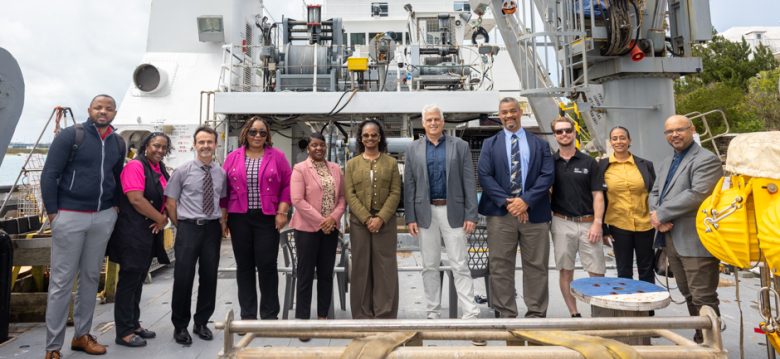
The Minister of Education, the Hon. Crystal Caesar, JP, joined public school science instructional leaders on a visit to the Bermuda Institute of Ocean Sciences (BIOS) on 15 April, reinforcing the Ministry’s commitment to expanding high‑quality STEM learning opportunities for Bermuda’s students.
The visit comes at a pivotal moment, as BIOS’s partnership with Arizona State University continues to broaden global research and innovation pathways for young Bermudians. During the engagement, the Minister and educators met with BIOS leadership, including Director Craig Carlson and Dr. Mark Guishard, to explore how Bermuda’s science curriculum can be more closely aligned with real‑world ocean science, climate research, and emerging technologies.
Minister Caesar said, “I was pleased to tour the BIOS station and learn about the programmes. The event confirmed our shared commitment to expanding collaboration through curriculum innovation and better teacher training. By bridging lab and classroom, Bermuda prepares students to lead on environmental issues and support the island’s sustainable future.”
Education Officer for Science, Shannon James, emphasised the significance of the collaboration, noting: “In Bermuda, the ocean is part of our everyday life. It’s who we are. What excites me about this continued partnership with BIOS is the opportunity to connect our students to real science happening right here at home. These experiences spark a lasting passion for science and inspire our young people to take ownership of their environment and their future.”
As part of the tour, the group received a firsthand look at the Atlantic Explorer, BIOS’s premier research vessel. Captain George Gunther provided an overview of marine operations and demonstrated how the vessel supports critical ocean research worldwide.
Minister Caesar and leaders also explored BIOS’s Ocean Academy, which offers a range of innovative learning experiences, including:
- Experiential Excursions — Hands‑on activities aligned with biology, chemistry, and physics.
- Workforce Development — Exposure to career pathways in marine science, engineering, and environmental technology.
- High‑Tech Learning — Immersive virtual reality (VR) tools that allow students to explore deep‑ocean environments and observe microscopic organisms up close.
The partnership emphasises both academic achievement and environmental stewardship. Through Virtual Reality (VR)and immersive field experiences, students can directly observe the effects of pollution on marine ecosystems, strengthening their understanding of Bermuda’s environmental challenges and their role in protecting the island’s natural resources.